
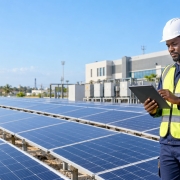
How Renewable Energy Can Reduce Business Operating Costs
For many Nigerian businesses, energy is one of the most significant operating expenses. Rising electricity costs, dependence on fuel-powered generators and interruptions to the public power supply can make daily operations expensive and unpredictable.
Renewable energy—particularly solar power—offers businesses a practical way to control energy expenses, improve reliability and support long-term growth. When properly designed, a renewable-energy system can reduce dependence on generators and provide cleaner, more dependable electricity.
1. Lower Electricity and Fuel Expenses
Businesses that rely heavily on diesel or petrol generators must continually pay for fuel, servicing and repairs. These recurring expenses can consume a substantial part of the company’s budget.
Solar panels generate electricity from sunlight, allowing a business to meet part or all of its daytime energy requirements without purchasing fuel. Although installing a solar-energy system requires an initial investment, the reduction in monthly electricity and generator expenses can deliver significant long-term value.
The amount saved will depend on the organisation’s energy consumption, operating hours, available installation space and the type of system selected.
2. Reduced Dependence on Generators
Generators are useful as backup power sources, but operating them for extended periods can be expensive. In addition to fuel costs, businesses must consider maintenance, replacement parts, engine oil and the possibility of breakdowns.
A solar or hybrid-energy system can reduce the number of hours a generator needs to operate. Solar panels can supply electricity during the day, while battery storage can provide power during outages or after sunset. The generator can then be reserved for emergencies or periods of unusually high demand.
This approach can extend the generator’s lifespan and reduce maintenance costs.
3. More Predictable Energy Costs
Fuel prices and electricity tariffs can change, making it difficult for businesses to prepare accurate operating budgets.
Renewable energy gives organisations greater control over their energy expenditure. Once a solar system has been installed, sunlight is available at no cost. Regular system inspection and maintenance may still be required, but these expenses are generally easier to plan than constantly changing fuel costs.
More predictable energy expenses allow businesses to budget with greater confidence and direct resources towards staff, equipment, marketing and expansion.
4. Reduced Downtime and Improved Productivity
Unstable electricity can interrupt manufacturing, customer service, communication, payment processing and other essential business activities. Employees may be unable to work effectively, while equipment can be damaged by sudden power interruptions or voltage fluctuations.
A properly designed renewable-energy system can provide more consistent electricity for critical operations. Battery storage and suitable power-management equipment can keep computers, internet systems, security equipment, lighting and essential machinery running during outages.
Improved energy reliability helps employees remain productive and enables businesses to serve their customers without unnecessary interruptions.
5. Lower Equipment Maintenance Costs
Frequent generator use and unstable electricity can contribute to equipment wear and costly repairs. Voltage fluctuations may affect computers, appliances, production equipment and other sensitive devices.
Renewable-energy systems typically include inverters, protection devices and power-management components that help regulate electricity supplied to connected equipment. When the system is professionally designed and installed, it can provide cleaner and more stable power.
This can help protect business equipment, minimise unexpected repairs and extend the useful life of valuable assets.
6. A Scalable Solution for Growing Businesses
Renewable-energy systems can be designed around a company’s current requirements and expanded as the organisation grows.
A small business may begin with a system that supports lighting, computers, internet equipment and essential appliances. Additional solar panels, batteries or inverter capacity can be introduced as the business expands or acquires more equipment.
This scalability allows organisations to invest according to their priorities instead of installing a larger system than they presently require.
7. Improved Environmental Responsibility
Customers, investors and business partners are becoming increasingly interested in how organisations manage their environmental impact.
Solar power produces electricity without the noise and direct emissions associated with fuel-powered generators. By adopting renewable energy, a company can reduce its dependence on fossil fuels and demonstrate its commitment to responsible business practices.
This can strengthen the organisation’s reputation and support its sustainability goals.
Choosing the Right Renewable-Energy Solution
Every business has different energy requirements. Before installing a renewable-energy system, the organisation should conduct a professional energy assessment.
The assessment should consider:
- The equipment and appliances that must be powered
- Daily electricity consumption
- Peak power requirements
- Operating hours
- Available roof or ground space
- Required backup duration
- Existing generator and grid connections
- Plans for future expansion
- Installation and maintenance budget
These details help determine the appropriate number of solar panels, inverter capacity, battery-storage requirement and system configuration.
Solar, Battery or Hybrid System?
A solar-only system can reduce daytime electricity expenses but may not provide power at night or during outages without battery storage.
A solar-and-battery system stores surplus energy for later use, while a hybrid system can combine solar power, batteries, public electricity and a generator. For many organisations, a hybrid arrangement provides a practical balance between cost savings and energy reliability.
The right option will depend on the business’s operations, budget and tolerance for downtime.
Start With a Professional Energy Assessment
Renewable energy is not simply about purchasing solar panels. The system must be correctly sized, installed and maintained to deliver reliable performance and long-term savings.
57 Synergy Limited provides tailored renewable-energy and business-support solutions for organisations of different sizes. We assess each client’s requirements and recommend practical solutions designed around their operations, priorities and budget.
Ready to reduce your business energy costs?
Contact 57 Synergy Limited to discuss a renewable-energy solution created for your organisation.